Wednesday, February 24, 2010

WP1: Statement of Purpose

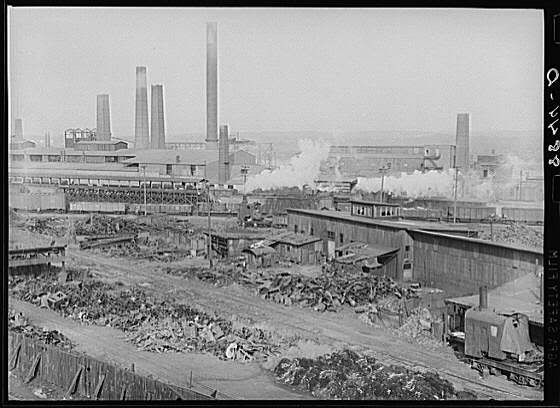
My main purpose in this first writing project is to find and then present a main argument forwarded by the photograph American Smelting and Refining Company, largest iron smelter in the world, explaining how its technical elements develop pathos, logos, and possibly ethos, when tied to the cultural context, support this argument (my "Main" purpose is to get a good grade with a secondary purpose of learning, the means of both being the statement above). I want to find an argument that is strongly supported in the photograph, deriving it from an technical analysis of its many elements. Once I have the final argument which I'm going to pursue, I'll seek to explain how those technical elements of the photograph forward that argument through their respective developments of pathos and logos, and less likely ethos (which doesn't involve much more in a photograph than keeping in focus).

My primary audience is my teacher for this class, the one who assigned it and will eventually be analyzing my analysis and grading its presentation. It is for this audience that this text (Writing Project 1) is being created and considering which it will be sculpted. Specifically, first, I will be following the guidelines for analysis that we have discussed thus far in class and established by the text that our class was provided with (Compose, Design, Advocate: a rhetoric for integrating written, visual, and oral communication). Secondly for this audience, the technical wording from that text will be invoked in the explanations of the photograph with its elements and the arguments that they forward.

There are also secondary audiences that may find, and with the will to, read my project, the first group being my classmates. This includes not only those in my class currently (who will be looking more likely out of interest although possibly an after-the-fact peer review) but also those future students who may be taking this class (most likely with the same teacher) who may look back at my project as an example (hopefully not for things not to do), just as we have looked back at the project of a former student already.

The rest of the possible secondary audiences include nearly everyone that can read English and has Internet access. In this era of expansive and yet growing connectivity of all things information, the Internet has created a network facilitating authors, photographers, creators, etc, to reach nearly endless audiences. Posted on blogger, my project will be completely open to access meaning given the will to find it (possibly searching for information of the photographer or photograph specifically or the photograph's subject) or the coincidence of wondering upon it, the project will be fully visible to see. For this audience, although using the technical wording provided in our book, I will attempt to keep everything understandable for outsiders who may not know the language set up or may use a different wording of their own.

The main context of my Writing Project 1 will be as a blog post on this blog (given the links and hierarchy of the class' blog) and will thus be viewed from the Internet digitally, (although because of its open access and the adaptability of digital text it may be easily be moved or even transcribed to non-digital contexts; i.e. printed off for review). The main impact of this context is that it means that the audiences will also have access to the rest of the information available through the Internet, some of which I will be utilizing directly in my project through the use of multimedia elements and hyperlinks, just as I have been in this statement of purpose.

Thursday, February 18, 2010

WP1: Pre-Writing Assignment 3

Starting towards the end of 1929, the Great Depression would strike and hard and fast. Within two weeks, $30 billion was lost from the U.S. economy. What started as a small drop quickly grew as panic spread, exasperating the problem and turning it into a cyclical downturn. The economic contraction continued until 1933, by which point the GNP had dropped 30.5% and consumer prices fell 24.4%. During this same time, industrial production fell 45%, house-building fell 80%, and more than 5000 banks had gone out of business. By the end of the contraction, 13,000,000 people were out of work, equated to unemployment rates of 25% of all workers and 37% of all non-farm workers. Businesses began to hang "No men wanted" to ward off the those looking for jobs and most of the people that were still employed still felt the fiscal tightening, either in reduction of pay or forced, uncompensated leave. The financial stresses of the contraction alone impacted many, leading to the anecdotal examples of the period's simultaneous downturn in mood, even causing some to take their own lives.

After the end of the primary contraction in 1933, the United States was still on a long road to recovery. Although actions were taken, like the creation of the WPA (the Works Progress Administration)and progress was made, the impacts of the depression continued to linger. Dropped again in 1937 by another decline, the U.S. wouldn't truly escape the Great Depression until the onset of the United States' involvement in World War II, starting in the early 1940's. With the revitalized industrial production and the job openings created by soldiers leaving for war, the economic recovery was underway, unemployment even dipping below 2% in 1943.

The picture American Smelting and Refining Company, largest iron smelter in the world was taken in November, 1938, still in the throws of the Great Depression. This given with the aforementioned statistic that industrial production had fallen by 45% (although by 1938 the United States was starting to see the signs of recovery, times were still bad since the additional recession in 1937) means that the American Smelting and Refining Company was very likely not doing very well, experiencing a large drop in production, leading to a drop in revenue, and finally leading to either a drop in wages or hours of work or outright layoffs as was the case with many industries.

The knowledge of this context deepens the impact of first, not seeing any people (workers) in the image (although the smoke stacks in the background are still churning giving indication of work being done, the lack of people creates the sense that the factory is more of an automaton than a place of work), and, second, the piles of scrap just sitting in the yard (likely not being used simply because the demand for product wasn't big enough). Also, at 1938, approaching nearly a decade of severe national economic depression, focusing on the scrap yard side, with not only its scrap/waste in the yard but the more run-down buildings, reflects the tired and run-down sense of the era.


Broad, Mark. "I remember the Wall Street Crash." BBC News. BBC News, 6 Oct. 2008. Web. 17 Feb. 2010. (Site)

Smiley, Gene. "Great Depression." Library of Economics and Liberty. Library of Economics and Liberty, n.d. Web. 17 Feb. 2010 (Site)

Tuesday, February 16, 2010

WP1: Pre-Writing Assignment 2

First to note is that there are no unified vectors of attention because there are no people visible in the image. This carries its own argument however, removing the people of the factory from the list of subject matter and continuing to further the image away from the organic (with the similarly noted lack of any kind of noticeable foliage), adding emphasis the obvious industrial motif. If the image were focused on some gathering of men working, or on break, or in some line, then the story told would be specifically different in the following the in the lives in the smelting company. The picture as it is though maintains its focus on the factory and its grounds.

That said the framing gives a more specific focus on the scrap yard in the foreground than the factory as a whole or any other specific part. The (relatively for high angle shots) low angle of the shot (its also unlikely that they would be taking detailed aerial maps for anything other than mapping during this time period) causes objects in the foreground to obscure those behind them, although there is the tendency for the objects (buildings) further back to be taller, meaning they can be seen, although not fully, until the large factory and the large smoke stacks after which only the far horizon (possibly not so far hills but we associate the fading to distance) is visible. All of this means that the scrap yard is given more focus in the hierarchy of the photograph, being the first at hand, the closest (showing more detail), and the least obscured. This continues the motif of industrialism as dirty, giving primary attention to the part of the factory with the least well kept buildings (those likely for storage) and the piles of scrap that although are meant for recycling and re-smelting are associated still closely with trash (especially when thinking of some closed down factory still with a lot a scrap that is left to rust or of the "redneck" with all kinds of scrap just lying around).

The cropping plays less of a role though it still deserves note. Not as stark as when a series of different cropped shots are displayed, its affects could probably be associated with framing without much difficulty. However the cropping does maintain and strengthen the rhetoric of the photograph. The main use of cropping is to either side, cutting off the edges of the factory and its grounds. First this re-emphasizes the focus on the American Smelting and Refining Company by not including any extraneous buildings, businesses, or even empty lots. Second, by the way the photograph is cropped, without any sign of the buildings ending shortly after the edge of the picture, our mind extends the factory and its grounds (or at least and more so other factories in a large industrial park) out significantly beyond just what is shown.

Now being a black and white photograph, there isn't nearly as much to talk about dealing with the colors of the picture. This picture was taken just after (really during) the introduction of color photography. This means that it is likely that its still black and white just because of the camera available, this supported by the fact that the other photographs in the collection with this one are all black and white, this one being no special exception. However, although not likely intentional, the black and white (mostly gray) nature can now be said to also aid the argument of industrialism, these tints, especially the grays of cement, metals, and smoke, commonly evoking those associations or industry, the antithesis of the organic.

Wednesday, February 10, 2010

WP1: Pre-Writing Assignment 1

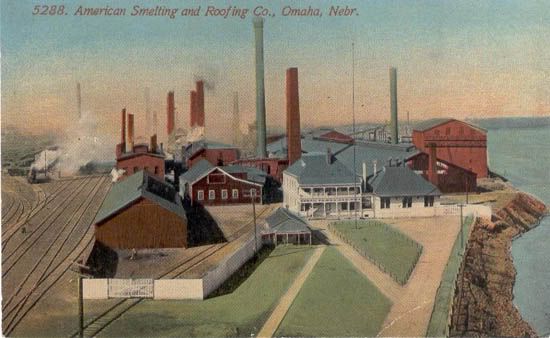
I chose my image from a list in the index of Omaha, this being a large iron works. In fact, according to the notes, it was the American , Smelting and Refining Company, the largest iron smelter in the world. The buildings are quite obviously industrial, the further looking newer and the closer looking older and used for storage. It is fairly simple to assume that the area surrounding the view of the picture is likewise industrial, planning usually taking place to keep industry together and away from residential or commercial zones. The foreground of the image seems to be in the worst condition of the facility, with the aforementioned rough-looking (some broken) likely-storage buildings, the mess in the yard, and the fence propped up by boards. Looking at the mess in the visible yard, one might first think it trash or waste just piled, but with the additional information of the subject being a iron works, the piles can be identified as likely metal scrap to be melted down and reused/recycled. I was going to say that you could assume a railway was near until I spotted the train(s) in the center right of the image.

The steel works probably provided steel for additional rail but more likely material for Omaha and probably surrounding areas like Lincoln. Supposedly being the largest iron smelter in the world at the time, it is even vary likely that it received and shipped materials and product from/to places very far away. Taken in 1938, the image shows the factory during the Great Depression. This was probably a source of many jobs for the region, although I wouldn't be surprised if they had experienced their own amount of layoffs due to decreasing business (although it was possibly revitalized during the public work programs being a producer of building materials). That means that these grounds were full of not only the imagined image of the typical factory worker (poor, likely uneducated, even carrying connotations of dirty, rough, etc) but also others not typically factory workers but that had fallen on hard times like the many others, taking what they could get.

An interesting note, probably resulting from coincidence instead of planning or actual lack, the are no people visible in the picture, or cars, or anything non-industrial (the background/horizon being faded enough to make indiscernible). There aren't even any plants that can be identified in the image. The lack of anything organic makes the image appear more stark, emphasizing its industrial nature. This, when matched with the smoke and fading of the distance and the fact that the picture is black and white (just due to the technology of the time), create a sense about as far away from natural as you can get. Accompanying all our sense of the Great Depression as a whole along with ideas about factories (especially during times closer to the industrial era), the picture's elements also give a sense of drudgery/a place that you don't really want to be but may have to.

Tuesday, February 9, 2010

Weekly Blog Post 7

I'm not particularly interested in photography as an art form. Just as I tend to effectively be a passive learner, I am also often a passive observer in the sense that I watch the whole whilst thinking of else. In my honors creativity seminar we undertook a small photo-documenting project, given a place and required to take a certain number of pictures for several categories, like flora, building, or even sounds (take for instance my picture of my shadow while riding a bike). I left the project with relatively the same view of photography I took into it, that when it comes to visuals, I don't like to linger much longer than the short time in which I absorb the information. Although I may pause to examine an interesting detail or just admire the whole, I prefer to keep moving along, whether it be from a zoo to an art gallery. In the same way that I don't think or remember in narratives, neither do I do so in terms of pictures. Although I'm a very visual thinker, I'm also very conceptual in that thinking.

Although I don't know the "technicals" of photography as an art form, I do know how to handle a camera and digital images. The camera end of photography is hardly a problem with today's modern, digital cameras. We also worked digitally with our photos (for my creativity seminar), managing contrast and other levels to improve the picture quality. Finally, even an average amount of computer experience is more than enough to manage and store the photos after they've been taken.